Service Patterns

Six Patterns.
One Standard.

Every service we deliver begins as a broad client requirement and ends as a precisely adjusted system. Below are the six service patterns we apply — each one a structured methodology for converting a brief into an exact-fit digital outcome.
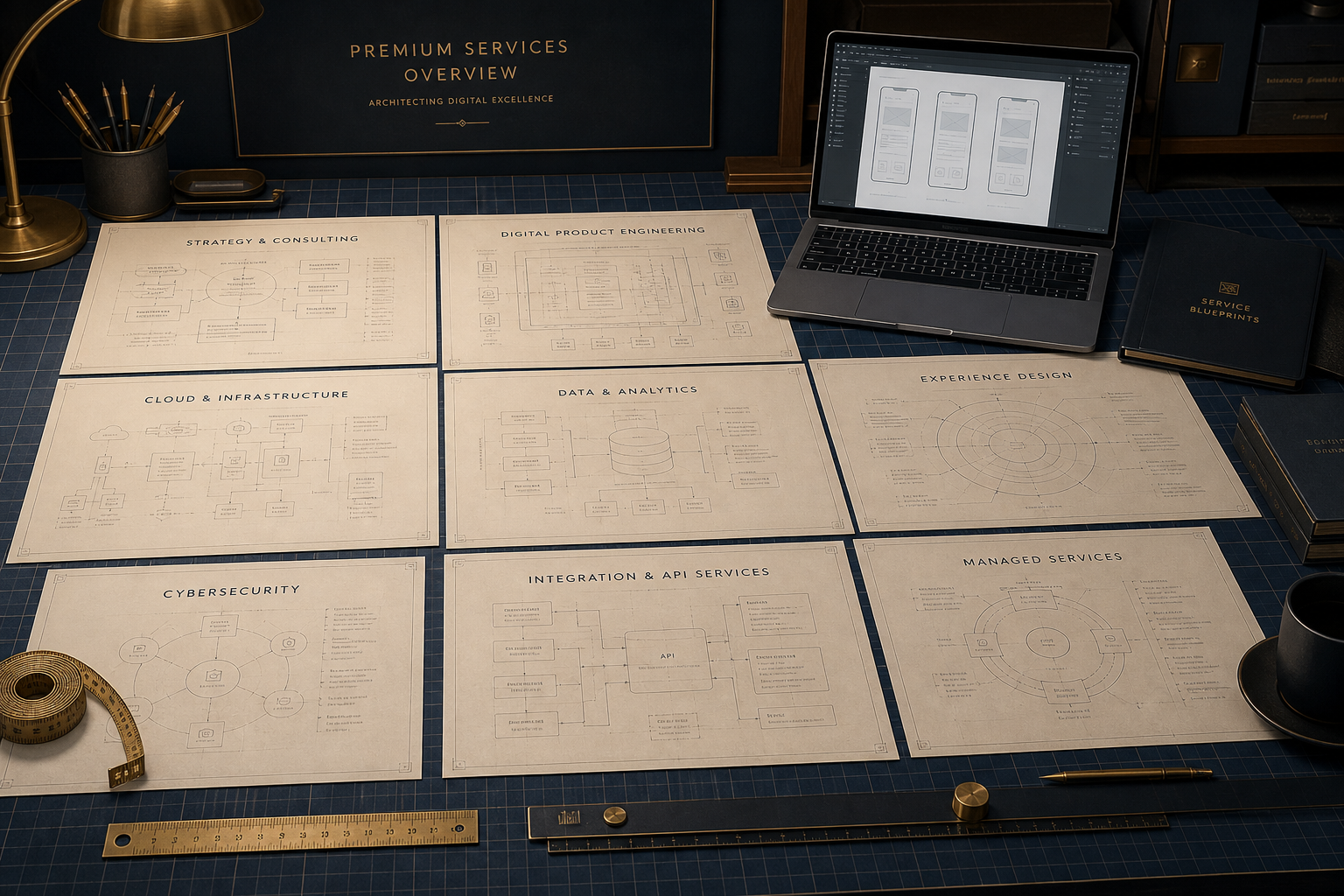
FAVLORA MARKS LTD service patterns overview workspace

Service Overview

What We Build

FAVLORA MARKS LTD operates across six core service areas, covering the full digital systems spectrum from software publishing and streaming infrastructure to mobile application development and cloud deployment.

FML-SP-01

Software Publishing & Computer Systems Design

Prepackaged software, custom programming and web portal architecture.

We design, develop and publish software systems aligned to your operational requirement. This covers both prepackaged software built for broad market deployment and fully custom-programmed applications designed around a specific client environment. Our computer systems design practice maps the full technical architecture before any component is built — ensuring that every system element serves a measured function within the agreed scope.

Web search portal architecture forms a distinct practice within this service — from information architecture and indexing logic to frontend interface systems and backend data management. We treat each portal as a precision measurement exercise: the information hierarchy is defined, the retrieval logic is mapped and the interface is adjusted to the expected user behaviour before the build begins.

Prepackaged Software Custom Programming Web Portal Architecture Systems Design API Development Backend Engineering

FML-SP-02

Media Streaming Distribution Services

OTT platforms, adaptive delivery and subscriber management systems.

We build end-to-end streaming distribution infrastructure for content owners, broadcasters and media companies. Our OTT platform practice covers the full stack: content ingest and transcoding, adaptive bitrate delivery, subscriber management, payment integration and the viewer-facing interface. Each platform is designed around the content model, audience geography and commercial structure of the specific client.

We measure peak concurrent load requirements, geographic distribution patterns and content rights complexity before selecting the infrastructure model. This prevents the common problem of streaming platforms built for average load but unable to perform during peak demand. Our delivery systems are adjusted to the actual audience behaviour of each client — not generalised estimates.

OTT Platform Build CDN Integration Adaptive Bitrate DRM & Rights Management Subscriber Systems Live Streaming

FML-SP-03

Social Networks & Content Platform Development

Network architecture, user connection systems and content distribution platforms.

Social network platforms require a different measurement approach than standard application development. The connection model, feed algorithm logic, moderation framework and content distribution pattern must all be precisely designed before any user-facing element is built. We begin every social platform engagement with a network architecture review — mapping the user relationship model, content flow and growth projection against the technical infrastructure required to support it.

Our content platform practice covers media networks, editorial publishing systems and community-led content environments. Each platform is adjusted to the specific content type, audience behaviour and editorial workflow of the client — ensuring the platform performs for the actual use case rather than a generic social media template.

Social Network Architecture Feed & Discovery Community Systems Moderation Tools Content Networks User Graph Logic

FML-SP-04

UI/UX & Digital Product Design

Interface design systems, user research and digital product development.

Our design practice is grounded in measurement before aesthetics. Before any interface is composed, we map the user journey, measure the interaction requirements and define the functional constraints of the product. The visual design system is then built to serve these measured requirements — not the other way around. This prevents the common pattern of beautiful interfaces that perform poorly under actual user behaviour.

We produce complete UI systems — component libraries, interaction patterns, typography scales and responsive layout frameworks — adjusted to the technical environment where the product will be built. Our design deliverables are production-ready: documented, specified and structured for direct handoff to development without additional interpretation.

UI System Design UX Research Component Libraries Prototyping Design Systems Brand Identity

FML-SP-05

Mobile Application Development

iOS, Android and cross-platform builds with full deployment support.

We build mobile applications starting from a measurement of your user base characteristics, device distribution and feature priority. This determines whether native iOS, native Android or cross-platform development is the correct approach for your situation — a decision that should be driven by the actual requirement rather than default preference. We do not recommend a framework before understanding the measurement.

Our mobile delivery process covers the full cycle: requirement measurement, UI/UX design, development, QA, performance testing, app store submission and post-launch monitoring. We maintain the CI/CD pipeline and deployment infrastructure to ensure that future releases follow the same measured, stable delivery pattern as the initial launch.

iOS Development Android Development React Native Flutter App Store Submission CI/CD Pipeline

FML-SP-06

Cloud Infrastructure & OTT Solutions

Cloud architecture, DevOps and scalable OTT deployment systems.

Cloud infrastructure that is incorrectly sized for its workload is one of the most common sources of operational waste in technology organisations. We begin every cloud engagement with a load measurement exercise — mapping the actual traffic patterns, data volumes, processing requirements and geographic distribution of the client system before selecting the infrastructure model.

Our cloud practice covers AWS, Google Cloud Platform and Microsoft Azure, with a particular focus on OTT delivery infrastructure where load patterns are highly variable. We design containerised architectures using Kubernetes or ECS, configure the CI/CD pipeline, establish monitoring and alerting, and implement cost optimisation controls — all adjusted to the technical capacity and financial constraints of the client organisation.

AWS / GCP / Azure Kubernetes & Docker DevOps & CI/CD OTT Infrastructure Security & Compliance Cost Optimisation

Fitting Questions

Common Questions

Answers to the questions most frequently raised before a fitting request is submitted.
An undefined requirement is a measurement problem, not a blocker. We run a structured brief intake process specifically designed to surface the actual requirement from an approximate one. This typically takes one to two sessions. The outcome is a documented scope that both parties have reviewed and confirmed — before any technical work begins.
We work with organisations at any stage. What matters is that there is a genuine requirement we can measure and a realistic commitment to the delivery process. Early-stage clients often benefit most from our measurement methodology, as it prevents scope expansion during development — a common cause of cost overruns in startup technology builds.
Yes. We regularly operate as an extension of an existing team — providing specialist capability in streaming infrastructure, mobile development or design systems where the internal team's pattern does not cover the requirement. We adjust our working model to fit the existing development process rather than imposing a separate methodology.
A standard OTT platform build — covering content ingest, adaptive delivery, subscriber management and the viewer-facing interface — typically runs between twelve and twenty weeks depending on the complexity of the content rights model, the number of target platforms and the degree of custom design work required. We provide a specific timeline estimate only after the requirement measurement is complete.
Yes. We offer post-delivery maintenance agreements that cover infrastructure monitoring, security updates, performance optimisation and iterative feature development. These are structured as measurement-led retainer arrangements — we review the system against the original fit criteria on a regular basis and flag where adjustment is needed before problems become operational issues.
We work on fixed-scope or time-and-materials engagements depending on the nature of the project. Fixed-scope agreements are appropriate where the requirement can be fully measured before the build begins. Time-and-materials arrangements suit projects where the requirement evolves through iteration. We are transparent about which model applies to each engagement and why, and we confirm pricing before any commitment is made.